

Research Progress on Action Mechanism, Clinical Practice and Safety Management of Major Ozone Autohemotherapy

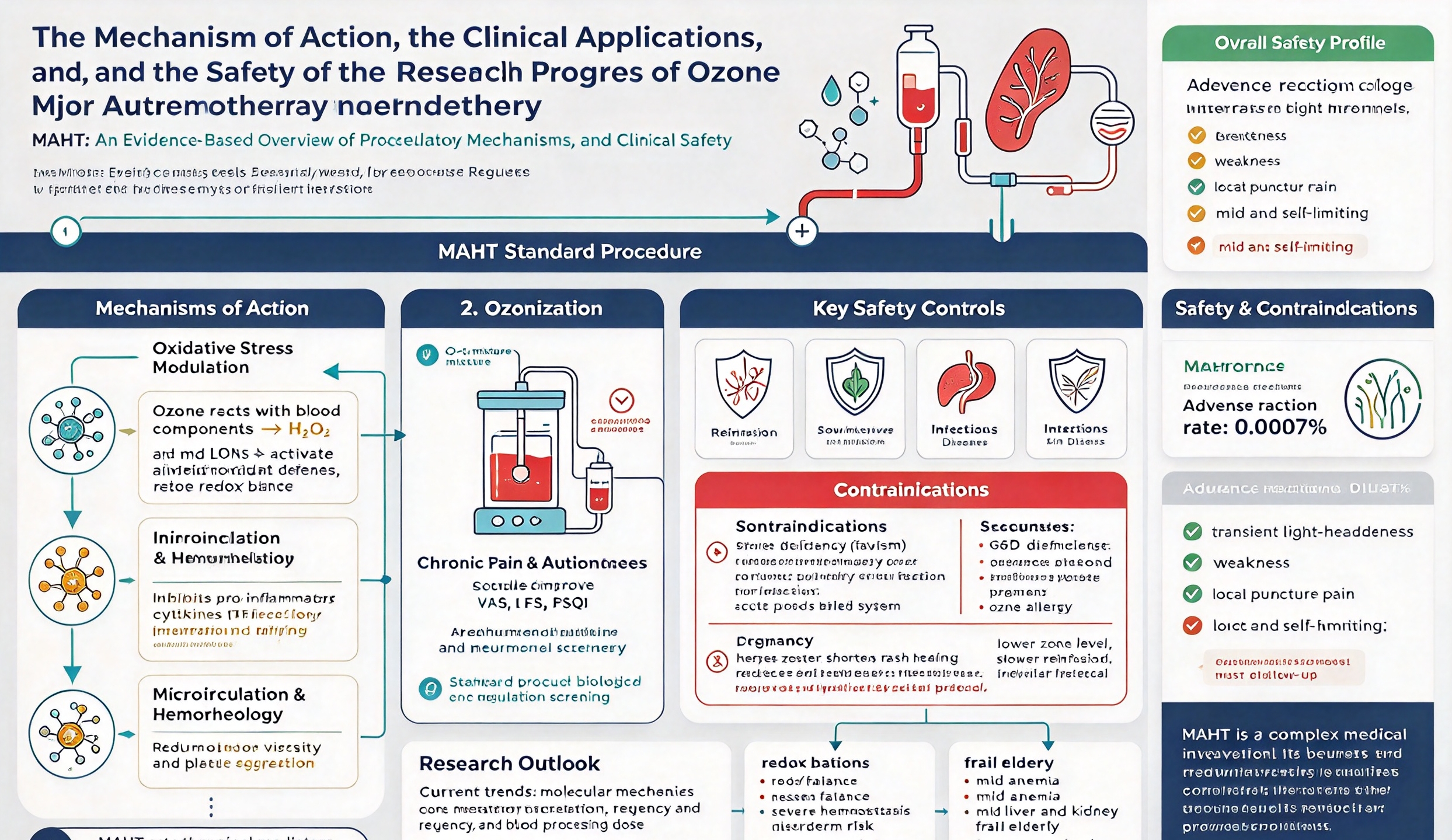
The Mechanism of Action, the Clinical Applications, and the Safety of the Research Progress of Ozone Major Autohemotherapy
Summary of the Study
MAHT is an innovative methodology of ozonotherapy. The concept of MAHT implies academic knowledge concerning the process of taking the patient’s blood from the vein, ozonizing it, and then returning the ozonized blood back to the body through re-injection. Over the last sixty years of clinical use of MAHT, this type of therapy is recognized as a low risk method due to its advantages of many targeted therapeutic effects. The particular purpose of the paper is to present the mechanism of action of MAHT along with the safety control management in its application.
Keywords: Major Ozone Autohemotherapy; the use of ozone; oxidative stress, immune system regulation; efficacy of the method.
Introduction
What is understood by Major ozone Autohemotherapy (MAHT) used in medicine, is a certain type of ozonotherapy but not a mild ozone autohemotherapy or local ozone treatment. The unique feature of MAHT technique is the return of the large volume of the venous blood to the patient after ozonization. Currently, MAHT is probably the most advanced type of ozone therapy with the highest level of evidence and the widest application in ozone medicine. Compared to traditional pharmacotherapy and even physical therapy, MAHT overcomes the limitations of local therapy.It conveys the action properties of ozone to organs and tissues via blood so that pathological modification takes place through various pathways. Clinical statistics show that MAHT technique was used on tens of millions of people all over the world, while the adverse reaction incidence rate was only 0.0007%, indicating a very good safety and practical feasibility profile of the technique. The last couple of years have seen some breakthroughs in molecular biology and precision medicine that enable a better understanding of MAHT mechanism, which moved from the level of macroscopic effectiveness to cellular, molecular, and metabolic approach. The therapeutic worth of MT in application to neurological diseases, autoimmune diseases, infectious diseases, chronic pain syndrome, and others has been established and tested in clinical practice.
2 Core definition and Standardized procedure of the MAHT
2.1 Technical definition
MAHT is referred to as an extracorporeal method of ozone blood treatment conducted in a completely sterile closed system. The standard protocol providing for the withdrawal of 50-150 ml of venous blood from the patient, anticoagulation, and mixing of blood with pure ozone-oxygen gas in a highly accurate dosage, is required. When the process of blood oxidation is finished, the blood is reinserted into the patient under non-pressure conditions. Everything happens in a closed environment, which excludes the possibility of cross-contamination. The approach of MAHT differs from that of autohemotherapy, which involves a small dose of ozone given subcutaneously.
2.2 Standardized clinical operating specifications
All over the world, MAHT standards, which are based on the standards of medical ozone treatment in Germany are being used and areThe major steps are presented below:
Assessment and preparation prior to treatment. The process involves an elaborate screening of patients in order to identify possible contraindications which may include issues related to coagulation, acute cardiopulmonary disorders, allergy to ozone, etc. Various sterile vacuum devices and sodium citrate anticoagulant are employed to make sure that blood does not coagulate.
The process of collecting blood from the body and mixing it with ozone. The extraction involves the collection of blood of 50-100 ml of blood at a constant pace. The concentration of ozone is maintained at 40 micrograms per milliliter. Shaking is performed continuously to make sure that ozone is equally interacting with blood.
Reinfusion of ozonated blood. The ozonated blood is reinfused back to the body slowly, through veins. The infusion is controlled to avoid excess tension within the blood vessels.
Standardized treatment protocols. The standard approach is to administer MAHT through two sessions per week, with each session being counted as one treatment unit. In total there should be 10 sessions, which constitute the entire course. The frequency of procedures is adjusted based on how severe the condition to be treated is.
3 Mechanisms that underlie MAHT
Medical ozone does not work directly as a treatment method. The mechanism behind its action lies in the way it interacts with various macromolecules in blood, producing mediators which, in turn, activate biological regulatory mechanisms in the human body. There are three primary mechanisms: oxidative stress modulation, anti-inflammatory regulation, and improvement of blood microcirculation.
Original citation/reference information not changed.3.1 Regulation of Oxidative Stress in Both Ways
Ozone quickly reacts with multiple blood components after entering the bloodstream from the physical parameters of blood such as amino acids, hemoglobin, and albumin to generate hydrogen peroxide (H₂O₂) and lipid oxidation by-products (LOPs). These products are the main mediators of the therapeutic action of MAHT (medical application of ozonotherapy). In addition, oxidative mediators resulting from ozone at low concentrations trigger the body’s antioxidant defense mechanisms, trigger the activity of antioxidant enzymes such as superoxide dismutase and glutathione, eliminate excess free radicals, and treat chronic oxidative stress. Moreover, MAHT helps achieve a balance between oxidation and reduction, repairs metabolism of the cells and thus instills protective oxidative pre-conditioning.
3.2 Bidirectional Regulation Concerning Inflammation and Immunization
MAHT is accurate in regulating inflammatory factors. It prohibits the release of pro-inflammatory cytokines such as tumor necrosis factor-α, interleukin-6, interleukin-1β and enhances anti-inflammatory factors, thus stopping chronic inflammation. Immunomodulatory mechanisms of this method work in two ways. In particular, it enhances the effectiveness of macrophages and lymphocytes.
3.3 Improvement of Hemorheology and Microcirculation
Ozone oxidative process improves blood composition leading to reduced blood viscosity and lower rates of blood cells and platelets aggregation.Moreover, it leads to expansion of microvessels in peripheral organs and improves the microcirculation of organs and tissues, reducing cellular ischemia and hypoxia. The application of this method ensures that tissues can receive the necessary oxygen and nutrients for their recovery and speeds the removal of metabolic products from the body.
MAHT has many clinical applications due to its versatility. It is widely used in neurology, rehabilitation medicine, pain therapy, dermatology, and infectious diseases. Numerous research papers have proven that its effectiveness is supported by clinical studies.
4.1 Neurological diseases
MAHT increases cerebral microcirculation and reduces oxidative damage to brain tissues when treating acute cerebral infarction and stroke, reduces neuronal edema and excitotoxicity, restores the motor functions of the arm and neurological functions, and minimizes the risks of disabilities after stroke. In addition, it has a favorable impact on the metabolism of oxygen in the brain and central inflammation of the brain. Studies show that MAHT used in conjunction with traditional medical therapy effectively improves treatment response rates of patients with acute ischemic stroke.
4.2 Chronic pain and autoimmune diseases
Since fibromyalgia syndrome is one of the most common diseases indicating the application of MAHT, it is common for patients suffering from this condition to suffer from pains all over the body, insomnia, fatigue, anxiety, and depression. It has been shown that MAHT is efficient in significantly improving patients’ VAS, FIQ, FSS, and PSQI outcomes, according to retrospective clinical studies.MAHT can effectively alleviate clinical manifestations of persistent fibromyalgia, positively influence the quality of life with stable efficacy over time, represent major supplementary treatment when standard treatment fails. Furthermore, for chronic autoimmune arthropathies, such as rheumatoid arthritis and ankylosing spondylitis, MAHT promotes the suppression of chronic inflammation in joints and enhances local microcirculation to relieve swelling of joints, pain, and limitation in the mobility.
4.3 Infectious and skin diseases
In case of herpes zoster and postherpetic neuralgia, MAHT shortens the time needed for rash healing while considerably decreasing the probability of residual pain by means of immune regulation of antiviral activity, suppression of neuroinflammation, and improvement of neural microcirculation. The results of metabolomics confirm that introduced MAHT takes place at the level of metabolic pathways and allows shortening the time for full remission of herpes zoster and decreasing the occurrence of postherpetic neuralgia. Furthermore, for infectious diseases, such as chronic hepatitis virus and recurrent infections of the respiratory tract, MAHT improves body protection from viruses in order to help control the infection and assist in decreasing the possibility of the disease that recurs.
4.4 Metabolic disorders and chronic fatigue syndrome
For patients suffering from chronic fatigue syndrome and metabolic syndrome MAHT is effective in balancing body oxidation system, and improving metabolism and fighting inflammation. MAHT restores relief from some side effects of persistent fatigue, weakness, and sleep disorders, improves dyslipidemia, and corrects glucose metabolism.5 Management of Clinical Safety and Contraindications
5.1 Adverse Effects and Management Foundations
MAHT is characterized by a remarkable overall safety profile with only occasionally occurring extreme adverse reactions. Only a slight number of patients may suffer from fleeting light-headedness, weakness or localized puncture pain, which are transient and alleviate instantaneously. Most clinics have adverse episodes caused by non-standard operating processes, too big ozone concentration or rapid reinfusion. Strict safety rules imply that all procedures need to be completed carefully in a sterile closed system to prevent contamination of blood; ozone concentration is calculated very attentively to prevent oxidative effects of the ozone at high concentration; rate of blood collection and reinfusion are strictly controlled so as to keep blood vessels from stress response; cardiopulmonary and coagulation screening is conducted before the procedure, and all vital indications are monitored during the procedure.
5.2 Absolute and Relative Contraindications
Absolute contraindications include glucose-6-phosphate dehydrogenase deficiency (favism), serious disorders of hemostasis, advanced pulmonary or cardiovascular failure, acute profuse bleeding, allergy to ozone and pregnancy.
Relative contraindications include mild anemia, mild liver and kidney diseases and frail elderly people. For these populations, ozone level should be lowered, the speed of blood reinfusion should be slower, and methods used for these patients should be changed according to the situation.
6 State of Research and Perspective
Owing to the developments in clinical research of MAHT, the emphasis has been made on the exploration of molecular mechanisms and metabolic regulation rather than only on the efficiency of this method. Experts agree that it is crucial to personalize ozone concentration, treatment frequency and blood processing dosages in order to achieve effective and safe treatment. There cannot be a uniform approach for the treatment of different patients, thus it is necessary to come up with personalized protocol for MAHT application.
However, there are still limitations of current clinical researches, including small sample sizes, a lack of multicenter studies and long-term clinical trials. So, there should be more clinical trials with numerous patients, randomized and controlled trials with follow-up studies to specify how to achieve the best treatment results, understand how MAHT works and ensure its long-term safety.