

Ozone Injection: Principles, Applications and Standards

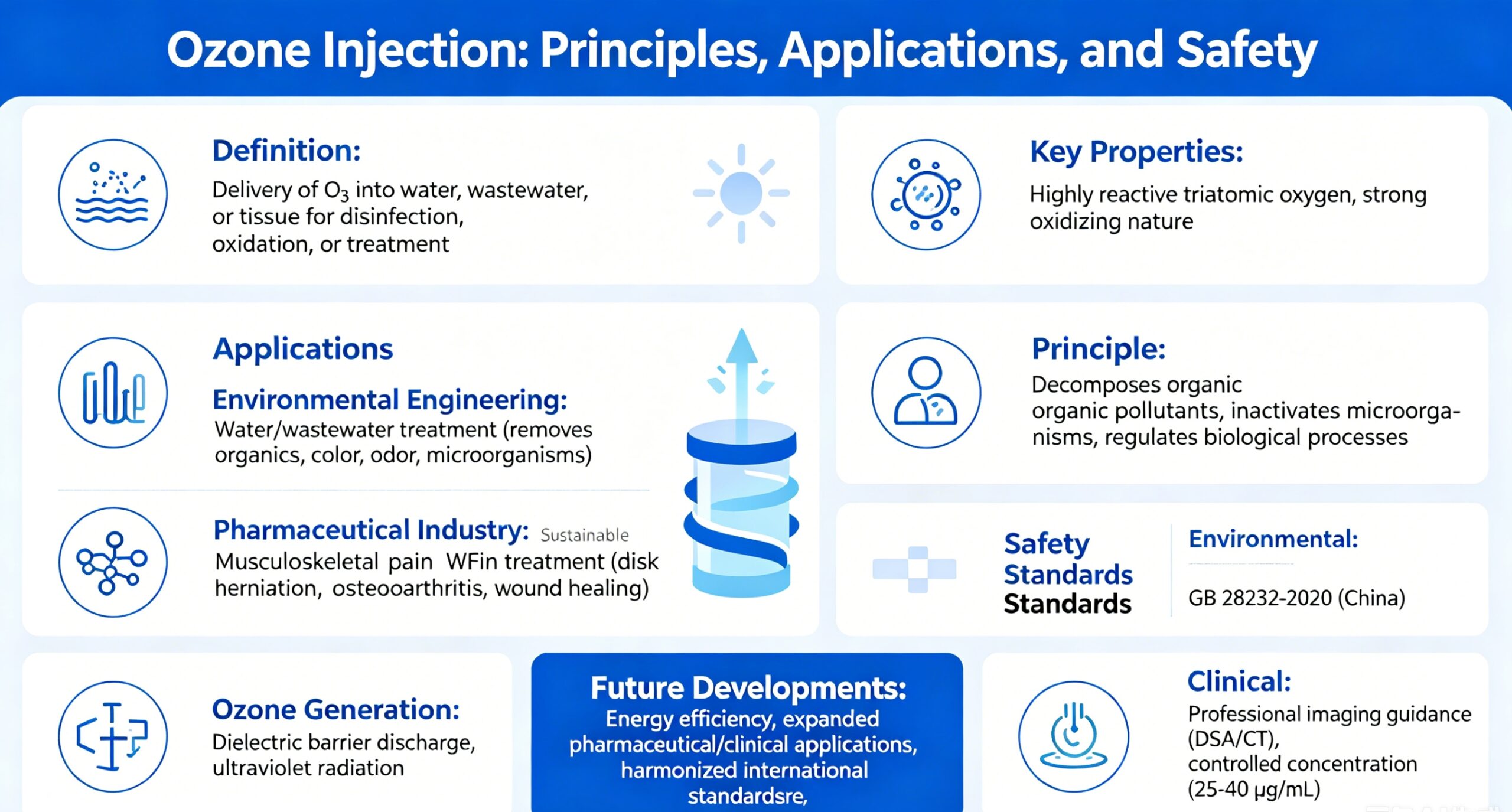
Ozone injection is the delivery of ozone (O₃), a highly reactive triatomic form of elemental oxygen, into a targeted medium (water, wastewater, or tissue) for disinfecting, oxidizing, or treating purposes. Ozone’s very strong oxidizing nature has made it the preferred method of choice for applications in environmental engineering, the pharmaceutical industry, and clinical medicine. Ozone injection must comply with strict operating standards for safety and efficacy.
The principle of ozone injection is based on ozone’s ability to decompose organic pollutants, inactivate microorganisms, and regulate biological processes. Ozone is generated using dielectric barrier discharge or ultraviolet radiation and is accurately injected into the desired medium with specialized dosing devices. Because of the rapidity of ozone’s reaction, no excessive chemical additives are recommended and therefore, ozone is eco-friendly and efficient compared to traditional disinfection processes such as chlorine.
In the field of environmental engineering, ozone injection is the cornerstone technology for advancing water and wastewater treatment processes. Ozone is an effective means for removing refractory organics, color, and odor in addition to harmful microorganisms without producing any known carcinogenic metabolites (for example, trihalomethane (THM)).
Municipal drinking water treatment plants typically employ ozone in both the pre- and post-ozonation phases of treatment. Manufacturing industries (such as food, petrochemical and textile) also rely on ozone injection to meet discharge and/or reuse standards.
An ozone injection system consists of an air source, ozone generation, a reaction for contact time, and a means to eliminate ozone present in the exhaust. The mass transfer efficiencies for ozone ranges between 85 and 95%.
Ozone injections into the pharmaceutical industry can serve as a new sustainable alternative to producing water for injection (WFI). Ozone can effectively purify water at room temperature using less energy than traditional distillation processes and generating fewer emissions. Although pre-ozonation occurs throughout the world, the continued popularity of strict distillation standards in certain geographic areas accounts for the limited use of ozone to produce WFI water.
Ozone injection in clinical applications is used to treat musculoskeletal pain, including lumbar disk herniation (intradiscal injection to shrink the bulging disk), knee and hip osteoarthritis (intra-articular injections to reduce inflammation), chronic wounds (to stimulate healing/repair). However, the clinical application of ozone injection remains highly controversial. Due to a lack of long-term data to support the efficacy of ozone in treating cancer or HIV/AIDS, the U.S. Food and Drug Administration prohibits the use of ozone injections for these conditions due to the potential risk associated with administering high concentrations of ozone in the human body.
The use/operation of ozone injection in both environmental and clinical settings must be performed in accordance with applicable safety and standardization protocols. In environmental settings, there are numerous safety promulgations, including the State of China’s GB 28232-2020 standards for the design and operation for ozone injection systems. In addition, clinical use must employ professional imaging techniques (such as DSA or CT scanning) to guide ozonation procedures and to maintain controlled ozonation concentrations (25-40 µg/mL) to avoid potential adverse treatment outcomes.
As an evolving, versatile, and environmentally-friendly technology, ozone injection continues to be improved through advancements in ozone generation, control, injection, and treatment, and will continue to play an important, beneficial role in future environmental protection and healthcare. As both environmental and healthcare applications of ozone continue to expand, future developments will focus on augmenting the energy efficiencies of ozone and the expansion of the pharmaceutical and clinical applications of ozone, as well as the development of harmonized international standards for ozone.
На данном портале вы сможете почерпнуть нужную информацию.
https://ivecodom.ru/home/avtomobil-okhvachennyy-plamenem-stal-ognennoy-pletyu-na-ul-mashinostroiteley-673/
Тут портале есть шанс почерпнуть интересную информацию.
https://healthcoach.myfashionacademy.ru/TrvsPV7qm62M/
Здесь сайте вы сможете отыскать нужную информацию.
https://omskapteka.ru/info/477-privatnyy-oazis-na-maldivakh-ozen-life-maadhoo.htm
Тут ресурсе удастся отыскать интересную информацию.
https://ipcfms.ru/read/393-mobilnyy-opyt-v-randx-casino-kak-igrat-so-smartfona.html
На данном веб-сайте можно получить нужную информацию.
https://sorrybabushka.ru/interesting/297-kaluzhane-zaplyasali-v-ritme-zayki-yarkaya-razminka-na-semeynom-festivale.html
Тут портале можно обнаружить нужную информацию.
https://wolgograd.ru/column/2686-community-and-responsible-gaming-initiatives-at-beepbeep-casino/