
PES H200 EBOO Filter: The Industry Benchmark for Extracorporeal Ozone Therapy

The EBOO filter is the main filtration system in the procedure known as Extracorporeal Blood Oxygenation and Ozonation (EBOO). It is a high-flux polyethersulfone (PES) dialyzer membrane which eliminates not just the circulating waste matter, but also the oxidized lipids and inflammatory debris and at the same time, ensures pure oxygen and ozone are mixed with the blood outside the body. In this guide, you can learn how this filter works, what is needed for it to function properly, what its specifications are, and why the PES H200 membrane represents the benchmark in the industry.
What Is EBOO Filter?
EBOO filter is a single-use filtration cartridge whose technology is that of a dialyzer. Its purpose is for the closed-loop extracorporeal blood system. The process of EBOO is a straightforward procedure where the patient donates about 2 liters of blood from a peripheral vein, and then the blood is being pumped through a filter membrane where it is mixed with properly measured ozone and oxygen mixture being then redirected to the patient.
The technology utilized by EBOO filter allows having an opportunity to perform continuous blood filtration.
How The EBOO Filter Work
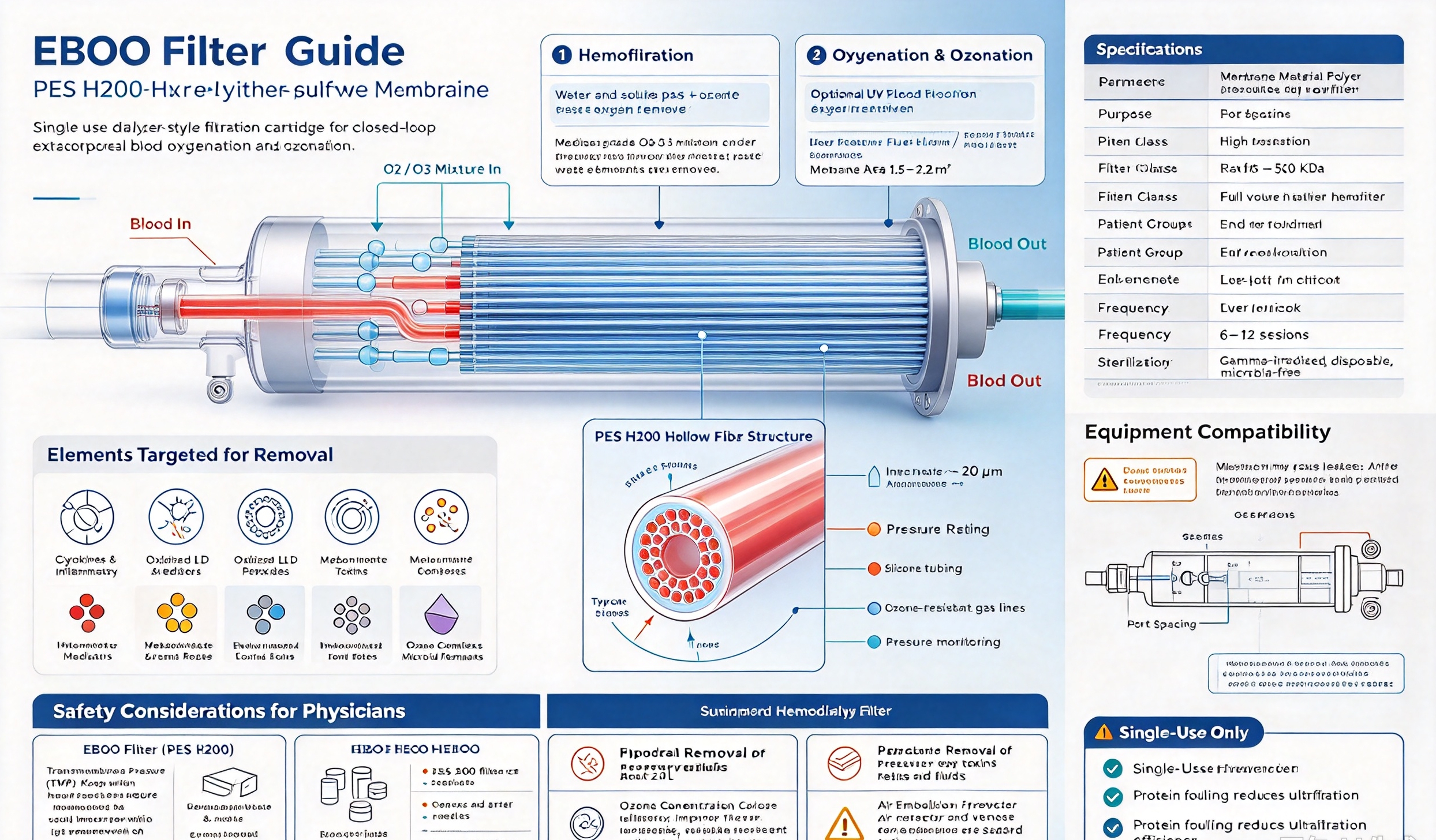
The EBOO filter has three main principles of action:
- Hemofiltration – in this process blood contacts a PES semipermeable membrane; under pressure the water and solutes presented in the blood leave it first and get rid of waste elements.Oxygenation and ozonation: While passing through the fibers, the blood is injected with a medical-grade oxygen-ozone mixture on the outside of the membrane. The ozone passing through the fibers reacts with erythrocytes, plasma proteins, and immune system cells, thereby initiating the redox signaling and stimulating the antioxidant Nrf2 pathway.
UV blood irradiation (UBA) alternative: A lot of EBOO setups incorporate a UV step past the filters, where the blood is manipulated with UV light after it has already been ozonized, before returning back to the patient. While the filter does not produce any UV, it makes the already treated blood cleaner from any impurities that would obstruct the light from penetrating.
PES H200 High-Flux Membrane: Basic specifications. The most widely-used of EBOO filters is the PES H200 high-flux filter made from the biocompatible hollow fiber polyethersulfone (PES).
Parameter(Common specification)
Material used in the membrane: polyethersulfone, hollow fibers;
Class of filter: high-flux dialyzer/hemofilter;
Molecular weight cut off: roughly 30-50 kDa;
Productive area of membrane: 1.5-2.2 m2;
Diameter of fiber’s inner hole: roughly 200 micrometers
Rate of blood circulation: 50-150 mL/min for EBOO circuit;
Type of connection: Luer-lock; ports for dialyzer;
Type of sterilization: gamma-irradiated, disposable, microbial-free;
Reason for using PES is that it is more biocompatible than cellulose or polysulfone.The EBOO Filter is effective at eliminating the following elements.
Because of its ability to filter materials at a high rate, the PES H200 filter is able to trap cells (both white and red blood cells, platelets, and albumin) while permitting the passage of low molecular weight substances through its pores.
Substances that can reportedly be found in the EBOO-treated blood include:
- Cytokines and inflammatory mediators
- Oxidized LDL and peroxides
- Metabolic waste and uremia-related solutes
- Environmental toxins and complexes bound to metals
- Immune complexes and remnants of microorganisms
It is worth noting that this membrane does not filter blood the way a dialysis machine does; whereas the former filters blood as per its size, the ozone treatment in the process is responsible for its antibacterial and immune modulatory action. It is advisable for practitioners not to advertise the filter as an all-in-one device for blood sanitation.
Using the EBOO Filter in Combination with Other Equipment
EBOO machines do not work with every available cartridge. The PES H200 filter that is installed in the 2026 EBOO O3 Research Device has to possess specific characteristics such as port spacing, pressure, and gasket size that perfectly match the machine specifications. If a standard high-flux filter is used in this system, it can result in: - Leaking at the interface between the filter and housing
- Improper TMP readings
- Various ultrafiltration rates
- Incorrect ratios of ozone to blood (O:B)
A typical EBOO disposable kit includes: - 1 PES H200 filter cartridge
- Silicone tubing
- Venous and arterial needles
- Ozone-resistant gas lines
- Pressure monitoring.The Reusable Nature of the Filter
A fresh, gamma-sterilized PES H200 filter is used in every EBOO session. It is inadvisable to reuse dialyzer membranes after EBOO sessions because:
- The fiber wall experiences protein fouling, resulting in decreased ultrafiltration efficiency.
- The presence of residual ozone and blood bioproducts poses a contamination threat.
- Clinical safety standards require that single-use sterile components be utilized in extracorporeal circuits.
- Membrane integrity cannot be assured after exposure to blood.
Differences Between EBOO Filter and Standard Dialysis Filter
The EBOO filter employs high-flux membranes although it is used in a circuit that differs in principle from that of the standard dialysis filter:
Feature
EBOO Filter (PES H200)
Standard Hemodialysis Filter
Purpose
Filtration + ozonation + oxygen delivery
Removal of excretory toxins and fluids
Blood volume per session
About 2.0 L
Full volume of blood for up to 5 hours
Dialysate
No dialysis; ozone on the gas side
Dialysis with electrolyte solution in a bath
Patient group
Wellness / integrative medicine
End-stage renal condition
Frequency
Typically conducted in 6–12 sessions
Performed three times per week for life
Safety Considerations for Physicians
- Transmembrane pressure monitoring: TMP must be kept between the boundaries given by the manufacturer to avoid hemoconcentration / rupture of the membrane
- Ozone concentration calibration: It’s crucial to ensure that the EBOO apparatus delivers the exact ozone dose (which is adjustable, generally from 1 to 35 gamma/µg/ml); if it is too high, hemolysis will occur, and if it is too low, it will not produce any therapeutic effects.Anticoagulation: Low-dose heparin or citrate is employed to prevent any coagulation happening in the tubing and filter in a 45 to 60-minute circuit.
Air embolism prevention: The air detector and venous drip chamber are regular safety mechanisms that are also included in the dialysis circuit.
Common Questions
What does EBOO literally mean?
Extras corporeal Blood Oxygenation and Ozonation is what is meant by EBOO. It is the latest form of intervention that entails continuous filtering, ozonating, and oxygenating of blood through a circle process outside the human body.
Which filter is used for EBOO?
The PES H200 hi-flux polyethersulfone dialyzer membrane is used for EBOO operations. This filter is a new and gamma-sterilized hollow-fiber cartridge which is compatible with all EBOO devices used in research.
How much blood is filtered during EBOO?
Around 2.0 litters of blood are filtered during a 45-60 minute procedure. This means the whole blood volume goes through the filter several times.
Is the EBOO filter the same as that of dialysis?
The technologies used in both cases (high-flux PES) are connected but there is still a difference in the circuit. A dialysis filter is able to use a bath for electrolytes in order to eliminate harmful substances while the EBOO filter is applying gas ozone infusion and does not require using dialysate.
Can EBOO filters be reused?
No. The EBOO filter can be used only once. Reuse can lead to protein fouling and membrane integrity loss.
Is EBOO therapy recognized by FDA?
PES H200 is well-known for having cleared by FDA and is classified as renal replacement device. The fact whether it can be used in EBOO therapy or not depends on the practitioner’s jurisdiction.
Main Points
The EBOO filter has only one version, namely PES H200 high-flux PES. It is the main piece of equipment as it provides continuous ozonation of blood.
The EBOO filter operates both on the principle of convection and ozone penetration through a hollow fiber.
It is very important to know the compatibility of the filter with EBOO device (spacing between ports, pressure characteristics, housing gasket) and never use generic filters without confirming their applicability.
Filters are single-use, gamma sterilized, and disposed after each patient.
When choosing consumables, it is essential to consider the published data regarding pore size distribution and biocompatibility.