

Guidelines, Clinical Applications and Research Progress of Ultraviolet Blood Irradiation (UVBI)

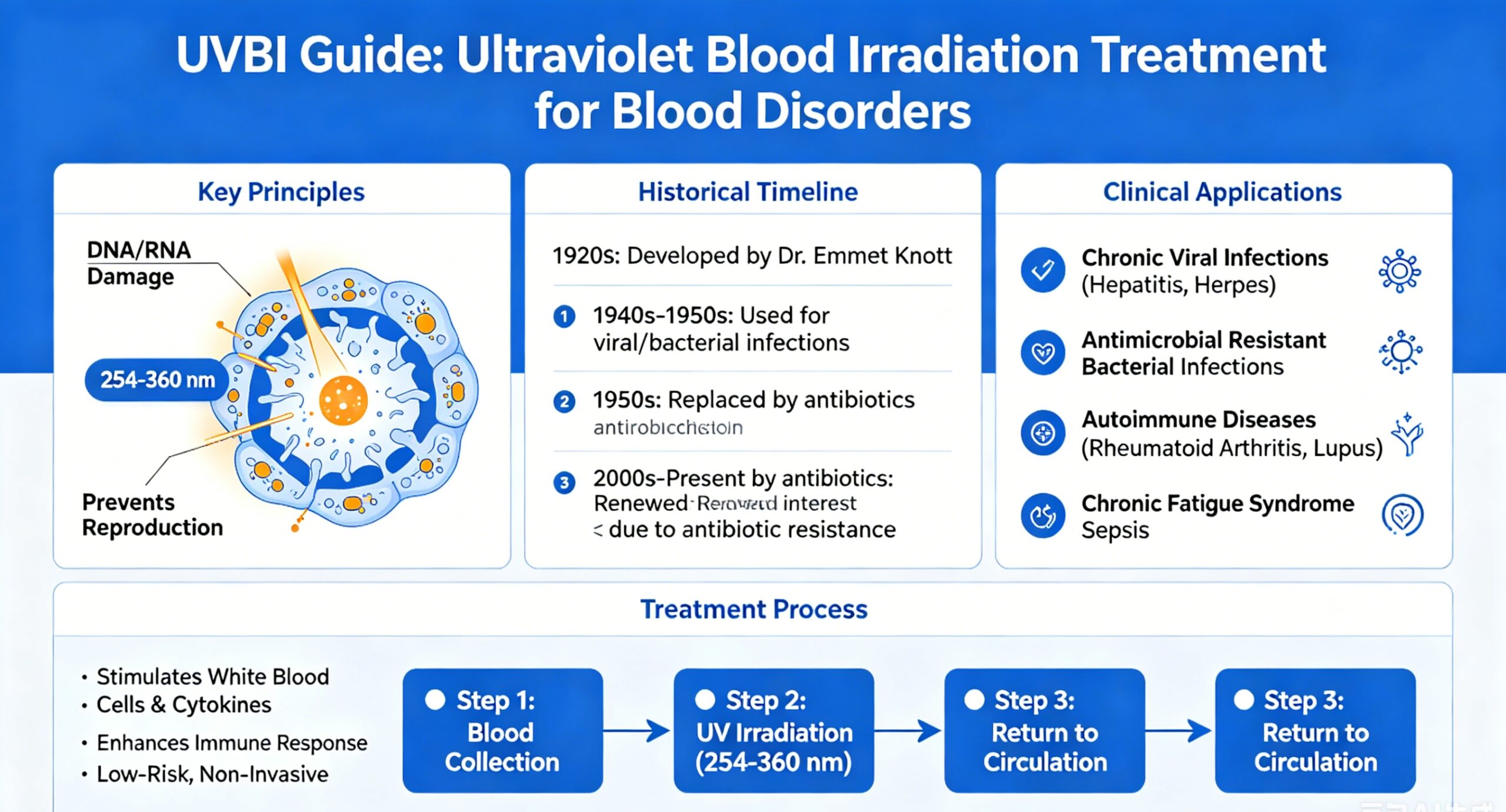
The UVBI Guide is a guide to UV treatment for blood disorders that includes guidance and information on the effects of UV treatment on blood (UVBI) and blood products. This includes information about preparing for the application of UV treatment and how to administer treatment.
Ultraviolet Blood Irradiation (UVBI) is an unconventional alternative therapy that exposes a small amount of blood outside the body to controlled levels of UV light before being returned to the body. Because of the rising prevalence of antibiotic-resistant infections and growing interest among consumers for modalities that are more natural in their approach (sources of healing), researchers have increased their clinical applications and work on finding effective ways (research studies) of treating patients.
The underlying principle for UVBI is its combined effects of destroying pathogenic organisms and stimulating the body’s immune system to destroy pathogens. The wavelengths of UV light administered for the procedure are typically between 254 nm and 360 nm (nanometers). The power of UV light allows penetration through the walls of pathogenic cells, damages the DNA and/or RNA of the cells, and prevents the cells from reproducing. Additionally, the exposure of blood to UV light stimulates the production of white blood cells and cytokines, which enhance the body’s immune responses against infections and control inflammation.
Dr. Emmet Knott initially developed UVBI in the 1920s; it was used successfully during the 1940s and early 1950s to treat patients with various viral and bacterial infections, inflammatory diseases, and liver/biliary disorders. However, the widespread introduction of antibiotics in the late 1950s resulted in the widespread use of antibiotics for treating infections; therefore, fewer patients received treatment with UVBI. Recently, the rise of people diagnosed with an antibiotic-resistant microorganism, with viruses such as Ebola, SARS and SARS-CoV-2, has led to renewed interest in using UVBI to treat these infections.
To date, UVBI has successfully treated patients diagnosed with 60 or more medical conditions, including chronic viral infections (e.g., hepatitis and herpes), antimicrobial resistant bacterial infections, autoimmune diseases (e.g., rheumatoid arthritis and lupus), chronic fatigue syndrome, and sepsis. Several studies are currently taking place to assess the potential of ultraviolet blood irradiation (UVBI) to provide therapy for immune modulation. Research shows that ultraviolet blood treated according to the UVBI protocol has higher levels of antioxidant activity in proteins when compared to untreated blood.
The main objective of UVBI, as a complementary and alternative modality, is to offer a safe and effective method for treating a variety of medical conditions; therefore, there is a wide variation in the amount of acceptance by the medical community for UVBI. Some hospitals are accepting the clinical benefits of UVBI in treating certain conditions, while others are only using UVBI for research.
Overall, UVBI is very safe for administering blood using UV light, and the risks associated with UVBI are minimal. The physician or authorized agent collects a volume of blood from the patient, passes it through a UV irritable tube and returns the treated blood back to the patient by means of the patient’s circulation.
As UVBI continues to receive more attention as a complementary therapy to traditional medicine, it seems that it will continue to be promoted as a viable alternative for patients suffering from a particular illness, for whom no traditional therapies have proven effective. Many patients that seek natural therapies are often encouraged to consider UVBI because of its low-risk, non-invasive nature.