

Research on Properties, Selection and Application of Spectroscopic Quartz Cuvettes

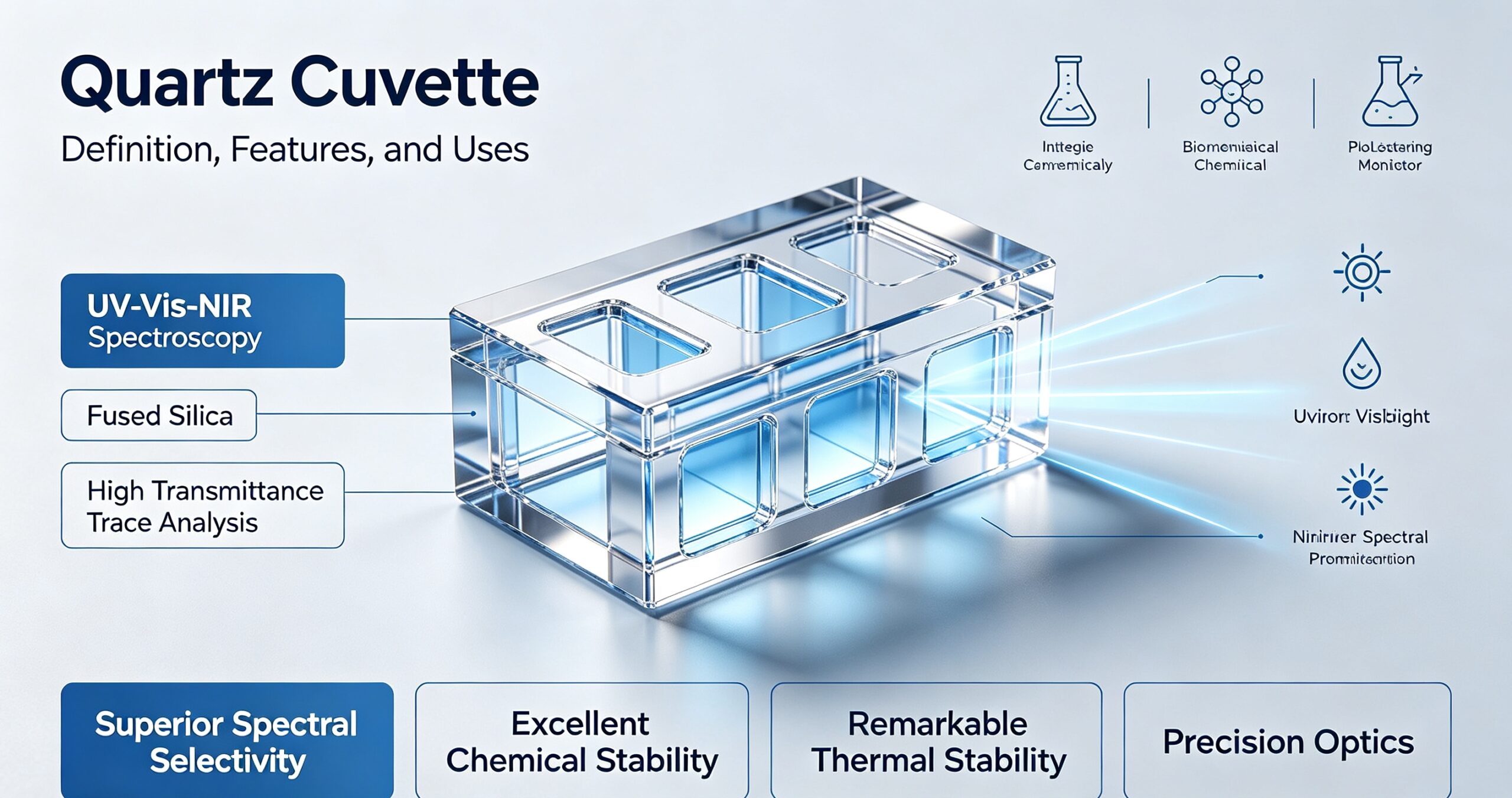
Definition, features, and uses of a quartz cuvette (2026)
The quartz cuvette, or the fused silica cuvette, is a high-quality optical device used in spectroscopy in the fields of ultraviolet (UV), visible, as well as near-infrared (NIR) light spectroscopy methods. The unique features of the quartz cuvette are the reasons for its popularity in areas like inorganic chemistry, biochemistry, pollution control, and the pharmaceutical industry. The present guide provides information about the properties of quartz cuvettes, various types of cuvettes, aspects that have to be considered while selecting cuvettes for usage, cases of cuvettes utilization, information about how the cuvette works as well as useful recommendations for maintaining one’s cuvette in a proper condition to get the most reliable results of spectroscopic analyses.
The distinct physiochemical characteristics of quartz cuvettes determine their unparalleled benefits in precise laboratory examinations:
- Superior spectral selectivity. JGS1 quartz cuvettes operate in deep ultraviolet regions, beginning from 185 nm, while being characterized by minimal light scattering and high transmittance, making them the best candidate for trace sample testing.
- Excellent chemical stability. Quartz cuvettes are inert to most solvents, acids, buffers, and water solutions, thus providing resistance to chemical corrosion and sample contamination during prolonged experimentation.
- Remarkable thermal stability. Due to their low coefficient of expansion (5.5 × 10⁷/°C) and heat resistance of up to 1100 °C, quartz cuvettes can withstand temperature fluctuations without deforming with respect to their optical properties.
- Precision of optics. Smoothly polished optical windows ensure both high optical parallelism (equal to 0.002 mm) and proper path length control (±0.03 mm for 10 mm documents), which is compliant with the requirements of NIST with respect to absorbance measurements.
Comparison of Different Types of Cuvettes
Use of wrong cuvette material can lead to the impact on absorbance indicator and result in baseline deviation and experiment failure. The table below presents positive and negative sides of different cuvette types.Cuvette Type
Wavelength Range
Benefits
Drawbacks
Ideal Usage
Quartz Cuvette
185-2500 nm
Transparent over whole spectrum, thermally and chemically stable, reusable, very little scattering of light
Expensive, fragile
UV-Visible spectroscopy, fluorescence tests, trace detection, analysis
Glass Cuvette
320-2500 nm
Inexpensive and trusted
It absorbs UV light so it cannot be used in UV spectrometry
Measurement of light absorbance in visible region
Plastic Cuvette
300-900 nm
Cost-effective
Not resistant to solvents, deforms easily, imprecise
Simple low-accuracy tests
Main idea: The only type of cuvettes that can be used in UV-spectroscopy and which is sensitive enough for trace analysis is quartz. The main types of quartz cuvettes differ in the following respects:
3.1 By Optical Path Length
The optical path length defines sensitivity as per Beer-Lambert equation (A=εcl). Longer paths increase sensitivity for diluted liquids, while shorter paths prevent excessive absorption for concentrated substances. - 10 mm quartz cuvette: The most widespread type of cuvette which can be utilized in most of UV-Vis applications with absorbance being optimal (0.1-1.0 AU).
- Long path cuvettes (20-100 mm): Designed for highly diluted liquids (e.g. monitoring water quality, detecting contamination) at significantly better sensitivity.
- Short path cuvettes (1-5 mm): Best suited for analysis of concentrated materials with the purpose of avoiding excessive absorbance.
3.2 By Design Style - Regular two-sided cuvette: The simplest- Cuvette with non-transparent walls: The cuvette consists of opaque walls that help lessen stray light interference and thus makes cuvette suitable for fluorescence studies and trace-element analysis.
- Cuvette with modular parts: A cuvette which has distinct mechanical parts thus can be assembled and dismantled easily and can be used with viscous fluids as well as with samples containing uneven, solid particles or made through specific procedures.
- Tight quartz cuvette: A completely sealed cuvette covered with PTFE which eliminates vapor losses. The cuvette is manufactured of quartz and is considered to be among the most important equipment in laboratories because of its great quality and durability.
- Ecology: Helps to measure small amounts of metals, organic pollutants and groundwater and wastewater.
- Pharmacy and medicine: Enables to measure biomolecules (proteins, acids).
- Chemistry and material science: Used for a wide number of spectroscopic processes and reactions.
- Agriculture and food industry: Used for the analysis of food and pesticides.
- Scientific and production research: Used for innovations in the field of spectroscopy, laboratory calibration and material testing.When selecting the right quartz cuvettes: Here are some important aspects that will assist you in selecting the right cuvettes to ensure cost-effective efficiency.
- Know the wavelength of measurement in order to decide JGS1 and JGS2 quartz to cut down on costs.
- Choose one of the two types of cuvettes, depending on the absorbance range selected based on the concentration of the specimen.
- Select a cuvette based on the type of experiment being conducted.
- Ensure Volume Compatibility: The volume of the cuvette (1.8 mL, 3 mL, or 10 mL) must be in accordance with the sample dose to make sure that the filling is done satisfactorily and no unnecessary volume of sample is wasted.
- Use Only Calibrated Precision Models: If high precision testing is necessary, employ cuvettes that indicate the path length tolerance according to NIST.
- Simple Operating Procedures and Maintenance Recommendations for Lasting Performance of the Cuvet
Quartz cuvettes are reusable products, but they are vulnerable and susceptible to scratching. If you adhere to the basic operating instructions you will ensure effective performance of cuvettes for a long time.
6.1 The Basic Steps to Operating a Cuvet
- Always clean the cuvet thoroughly before using it to avoid contamination of the baseline measurements.
- While using the specimens, ensure that no bubbles are formed.Absorbance issues and light scattering have arisen from bubbles. The optical windows must only be handled at polished areas to avoid fingerprints marking the cuvette. The cuvette should be placed vertically in a spectrophotometer, with its glass windows oriented parallel to a beam of light.
6.2 Washing and Storing Cuvette.
The cuvette needs to be washed with distilled water right after it is used; in case of heavy pollution, this should be done through soaking the cuvette in diluted ethanol or neutral liquid soap. Do not rub the windows with any sort of cloth or paper. Cuvettes should be kept in a comfortable storage place.
- Cuvettes FAQ
Q1. Is quartz cuvette reusable?
Yes, quartz cuvettes are reusable; thereby, its cleaning must be thorough.
Q2. What are the causes of instability in optical data?
The main causes of data instability are non-quartz cuvettes usage, the scratches on the optical windows, which left impurities and bubbles, or direct light acting on optical reasons.
Q3. What is the distinction of JGS1 and JGS2 quartz cuvettes?
While JGS1 quartz cuvette offers 185 nm transmission valid for the deep UV-test, JGS2 is suitable for ordinary optical tests.
Q4. What is the temperature limit and acid/base resistance of quartz cuvettes?
Quartz cuvettes withstand up to 1100 °C plus many acids and solvents. - General Summary
Cuvettes made of quartz are one of the most popular kinds of materials being employed for spectroscopic purposes because they possess high full-spectrum transparency, chemical resistance, and absolute accuracy as compared to vale and plastic.