

Ultraviolet Blood Irradiation (UVBI): Basics, Applications and Safety Guidelines

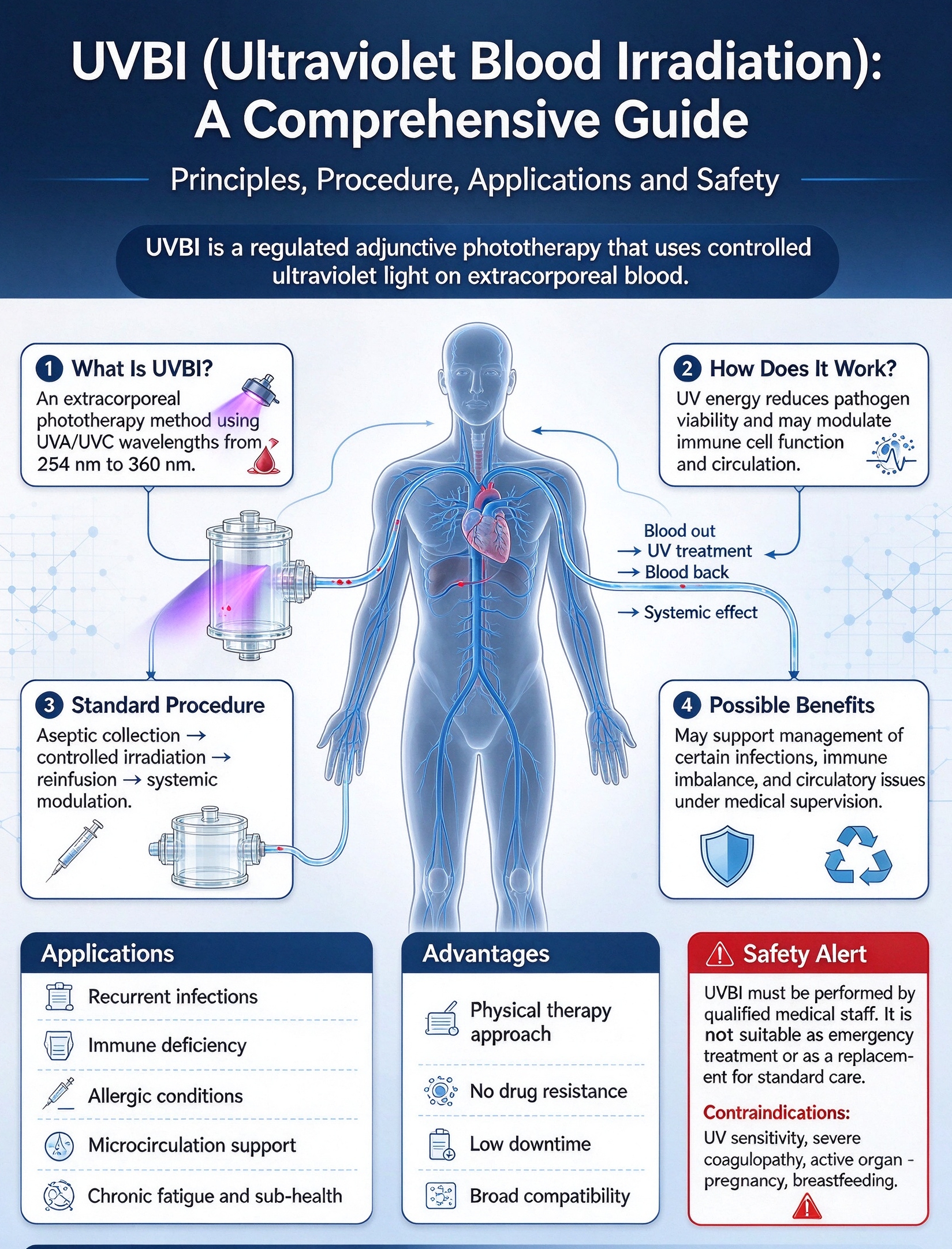
UVBI (Ultraviolet Blood Irradiation): A Comprehensive Guide – Principles, Procedure, Applications and Safety
The term UVBI refers to Ultraviolet Blood Irradiation, a popular, safe and reliable form of photobiomedical therapy. The essence of this method is taking a small amount of blood from the body, exposing that blood to ultraviolet light with particular wavelengths, and then returning that blood into the body after the treatment. Therefore, UVBI improves blood quality and enhances the work of the immune system and blood circulation processes. This procedure is widely used in the world. The text is intended for a general audience.
- What is UVBI?
Like many other forms of phototherapy, UVBI is also an extravascular technique. Compared to normal ultraviolet radiation, UVBI acts directly on the blood of the patient. As for the wave lengths used, UVBI regulations specify that only UVA and UVC waves ranging from 254nm to 360nm are applicable. Thus, another important point about UVBI is its non-invasive nature.
The procedure was developed approximately one hundred years ago to treat serious infections and blood poisoning, but nowadays its scope covers a lot wider range of health issues (including infectious diseases, disorders related to the immune and metabolism systems). Given its safety and low number of side effects, UVBI is considered one of the effective methods used in modern medicine.
The scientific basis for the success of UVBI lies in the fact that only five percent of the total volume of blood is enough to achieve the desired effect.Overview of the Mechanism of Action (Simple Scientific Explanation)
UVBI exerts its effects in two ways, namely pathogen destruction and immune activation. The biological mechanism is known.
The first mechanism is the destruction of blood-borne pathogens.
The bacteria, viruses, fungi, and resistant microbes within the blood absorb the ultraviolet light much better than the human blood cells. The penetration of the ultraviolet radiation through the pathogens’ membranes causes the death of the pathogen by interfering with their nucleic acids.
The second mechanism is the activation and modulation of the immune system.
The infusion of blood treated with ultraviolet light results in double activation of the immune system.
The first mechanism is based on the fact that dead pathogens act as antigens, providing the immune system with information about the pathogens and increasing its ability to fight them. This mechanism is particularly effective in the fight against resistant bacteria and viruses.
The second mechanism is based on the stabilization of the dysfunctional white blood cells by the ultraviolet light, with the increased permeability of the membranes and activation of the immunity.
The third mechanism is based on the restoration of the circulation.
This process is achieved through the optimization of the zeta potential and reduction of viscosity of blood.Each procedure has a time length of 30 to 40 minutes.
Collection of blood: Clinicians draw a small venous blood sample by taking all necessary aseptic precautions. The quantity is dependent on the patient’s weight and health status.
Ultraviolet irradiation: The blood is then put in a quartz chamber made of bacteria-proof material and transparent to UV rays. Special equipment will direct some ultraviolet radiation to the chamber at a specific wavelength and strength.
Reintroduction of the blood into the patient: After the blood has been re-irradiated and purified, it will be introduced back into the patient’s body.
Systemic modulation: The blood maintains its course through the body throughout multiple vortex cycles and achieves total elimination of pathogens and regulation of the immune system, as well as optimization of blood circulation.
4. Key Clinical Uses
Being bactericidal, anti-inflammatory, immunoregulatory and pro-circulatory UVBI is applied in medicine and in cases of sub-health:
Acute and chronic infections
This would cover viral colds, recurrences of respiratory infections, urinary infections, dermatomycotic infections and many more. It allows controlling chronic infections and inflammation due to antibiotic resistance.
Abnormal immune response
If the patient has some immune deficiency, has been ill too often lately (especially after operations) or suffers from atopic chal syndrome he/she will benefit from the 2-way immune modulation.
Blood circulation abnormalities
The patient is encountering symptoms of high blood viscosity, problems with blood microcirculation, feeling fatigued and dizzy.Only positive results for the people suffering from slow metabolism and fatigue syndrome; effectively used for those with the problem of insufficient microperfusion of the cardiovascular and cerebrovascular systems.
Chronic inflammation and formation constitution
Detoxification is the means of combating the chronic systemic low-grade inflammation caused by toxin accumulation and slow metabolism, reduces inflammation, and improves general conditions of a person suffering from exhaustion, dark skin condition, and constant tiredness due to being in a state of sub-health.
5. Main Advantages of UVBI
High safety: It is a technique of physical phototherapy without using any medicines. It is not causing any drug resistance and has almost no harmful side effects; hence it can be used for people with different constitutions.
Multi-functional: It combines all the functions of disinfecting, anti-inflammatory, and immunomodulatory effects. It has a better outcome than other single functional treatments thanks to its systemic improvement approach.
Minimally-invasive and convenient: It is a non-invasive technique that does not require the stay in the clinic and does not require any recovery.
Versatile: It can be used either alone or in combination with other therapies.
6. The group of patients who can have the treatment
People who are eligible to receive treatment include those with weakened immunity and infectious diseases, those who have chronic inflammation and fatigue syndrome, those who have high blood viscosity and poor microcirculation, and those who want to recover after surgical operations or illnesses. People who should not have any treatment include those with sensitivity to UV rays and severe coagulability disorders, oncological diseases, and serious dysfunctions of both hepatic and renal.
7. Most popular questions
Q1: Is UVBI harmful for healthy blood cells?
No. Normal human blood cells are highly resistant to ultraviolet rays, while the pathogens – on the contrary, are more than 5 times more sensitive to UV radiations used in UHD therapy. The doctors are using specific wavelengths and certain doses of the rays that provide both safety and treatment of harmful microorganisms.
Q2: How many treatments should be done?
The results are individual for people. Patients suffering from mild symptoms usually see the improvement in fatigue and immunity levels after the second or third session. People who have recurring problems need a course of procedures to activate the immunity system.
Q3: Is UVBI a new method of treatment?
Not a new one. UVBI method has its long history and numerous clinical studies are available nowadays without its treatment being still very effective against various kinds of illnesses.
Conclusion
ULtraviolet blood irradiation is a very effective treatment and has absolutely no side effects.