

Ozone Kits: Principles, Classification, Applications, Selection and Maintenance Guidelines

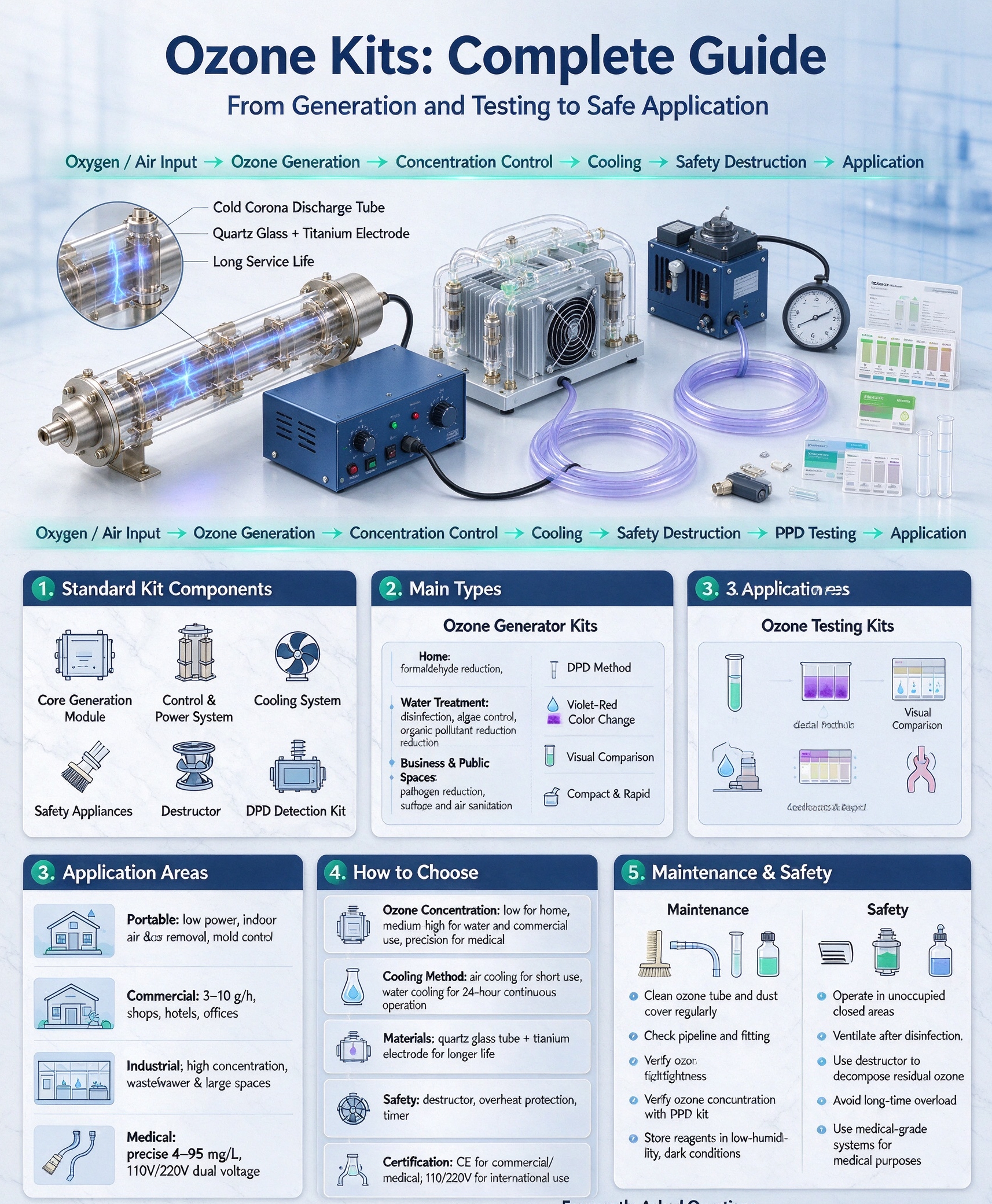
The ozone kit is a combination of professional equipment and accessories to use for ozone manufacture, detection, and practical ozone treatment purposes. The contents of the kit provide a complete solution for the whole process of ozone production, testing, and proper use. Ozone kits have great functionality, being applied to home processing, sanitation of businesses, industrial treatment of water, and auxiliary treatment in medicine. Ozone kits are indispensable in modern environmental processing and microbial control as they enable effective sterilization and odor removal. This article describes all existing types of ozone kits, their working principles, proper applications, selection criteria, and maintenance advice to help users make the right choice.
The ozone kit is the opposite of an independent ozone generator as it includes all parts and accessories needed. Thus, it does not require connecting separate parts and has less safety risk when using. An ozone kit includes 2 main types of equipment: ozone generation kits and ozone testing kits, which can be different.The standard components included in a primer ozone kit are such items as:
- Core generation module; cold corona discharge ozone tube (quartz glass mixed with titanium), considered one of the most important components of the ozone generator performing the conversion of oxygen into ozone and possesses long service life and steady output.
- Control and power system; Adjustable voltage regulating unit, concentration control unit, and timer, which assists in adjusting ozone output very precisely.
- Cooling system; an air cooling system or water cooling system which prevents the machine from overheating.
- Safety appliances; The ozone destructors, high-resistant silicone pipe, and protective fittings with the help of which residual ozone get destructed.
- The detection appliance; DPD chemical, color comparison card, and the test tube in ozone testing kit for ozone concentration detection.
Ozone kits are categorized according to the patterns of operations and the areas of application into ozone generator kits and ozone concentration testing kits with their different operational patterns.
- Ozone generator (sterilization and purification type)
The kit which is used mostly is the ozone kit because it uses cold corona discharge technology as the main operating principle. The kit uses ambient air or pure oxygen as the raw material that undergoes the process of breaking down around the aura to ozone molecules.On the basis of the output power of the product and its application scale, generator kits have the following types:
- Portable ozone kits: This type of generator has low power output and is light and easy to use mainly for indoor air treatment, as well as process water disinfection and deodorization.
- Commercial ozone kits: These kits provide good levels of ozone output (3g/h-10g/h), allowing long-term usage. This is the option for sterilizing malls, hotels, and workspaces.
- Industrial ozone kits: These are unique and highly concentrated types of generators. They work together with cooling systems and can treat industrial wastewater, sterilize food production, and clean large premises.
- Medical ozone generator: This type of generator is used for ozone therapy, has precise concentration adjustments (4–95mg/l), and works at both 110V and 220V.
- The Ozone Testing Kit
The ozone testing kit is based on the DPD method, being the most widely used method that allows for quick detection. The principle behind this kit is the action of ozone on the DPD reagent in a slightly-alkaline environment, leading to the formation of the violet-red dye. The user analyzes the obtained solution through visual comparisons.
The kit is compact, portable, and does not require any knowledge or preparation from a user.The Main Industrial and Civil Uses of Ozone Kits
Ozone is a powerful oxidizer that is effective in destroying bacteria, viruses, and fungi, decomposing formaldehyde, unpleasant odors, and organic pollutants, without causing any secondary pollution. Taking advantage of this feature, ozone kits can be used in various areas: - Purification of Air in Homes and for Domestic Uses.
Home ozone kits are used for formaldehyde removal indoors, hygienization of rooms, deodorizing from pet smells, and preventing mold in wet areas such as bathrooms and kitchens. The timer function ensures that people do not suffer from prolonged exposure to ozone and helps improve air quality in the home and solve common problems. - Water Treatment and Purification
Commercial and industrial ozone kits are used for disinfection of drinking water, cleaning swimming pool water, improving the quality of water used in aquaculture, and treating organic pollutants in industrial wastewater. Ozone easily destroys E. coli bacteria and algae in water, eliminating bad odors and colors, and allowing to replace the traditional chemical disinfectants for a safer purification process. - Disinfection in Business and Public Spaces
Places such as hotels, shopping malls, schools, or catering establishments may use simple ozone kits for cleaning closed areas and thus successfully destroying pathogens and eliminating unpleasant odor, which allows to avoid the disadvantage associated with previous disinfection methods and keep people safe. - Healthcare and Medical Treatment
Ozone kits intended for medical use are provided with exact concentration control for such applications as dental hygiene and local ozone therapy.It is by defining concentration output, the adjustable concentration output allows for safe as well as standardised medical use, while supporting accessories including oxygen regulators and medical masks meet clinical operating requirements.
Industrial Production and OEM Matching
Modular ozone tube kits have been extensively used to manufacture ozone treatment equipment as OEM products; they allow for custom assembly of air purifier equipment and water disinfecting equipment, which have proven to be efficient for 10,000 hours or more.Criteria for Professional Ozone Kit Choice
For achieving the desired efficacy and safety of the ozone systems, it is important that the users choose ozone kits taking into account the following basic technical characteristics:
- Concentration of ozone obtained: For home usage low-concentration portable devices should be selected; medium and high concentration continuous action need to be selected for water treatment and commercial disinfection; precision adjustable concentration professional devices should be selected in medical cases
- Cooling method: In case of short-time use air cooling types can be used; if continuous 24-hour functioning is needed water-cooling high-power system should be chosen
- Constituent materials: The best choice would be kits using quartz glass ozone tubes and titanium electrodes which have more corrosion resistance and carry out with longer life span.
- Safety features: It seems reasonable to choose kits that have ozone destructor, overheating protection and timing shutdown to prevent any damage from remaining ozone and malfunctions of the device
- Certificate matters: If the usage is commercial or medical – the device should be CE certified; dual voltage kits, meaning they can operate under the voltage of 110/220 V, are optimal for international operations
Daily maintenance and safe operation guidelines
Timely performance of maintenance work can contribute to prolongation of the ozone system’s service life and stabilisation of its performance level, while the adherence to the operational standards plays an important role in the prevention of any potentially hazardous problems.The manual of maintenance
Maintenance instructions - The upper side of the ozone tube and the dust cover must be cleaned regularly to avoid dust coming into contact and affecting how ozone is generated and how heat is discharged.
- The tightness of pipelines and fittings should be controlled regularly to eliminate the possibility of ozone leaks, which appear in the course of the aging of silicone parts.
- Ozone concentration should be differentiated frequently with the help of a special testing kit to be sure about the stability of ozone generated and about the efficiency of the sterilization process.
- The testing reagents should be stored in places with low humidity and no light to avoid possible failures of the reagents.
- Safety instructions
- Ozone production systems should be used in closed, unoccupied areas without people being present while the equipment is in operation.
- After disinfection operations, all the windows are to be opened and the ozone destructor must be turned on to decompose ozone completely.
- Avoid overloading the machines for a long time and use the appropriate amount of energy based on the area and the volume of the water being processed.
- It is necessary to use professional medical ozone systems made according to medical standards.
Conclusion
Ozone generation systems can be used for medical purposes, for environmental treatment, and for household needs. Different ozone production and testing systems work in a coordinated way to guarantee safe and controllable use of ozone. When choosing and using ozone devices, their model must be suitable for the requirements of a particular task, such as the efficiency of ozone generation, cooling system, and safety features.
Questions and answers
Q1: Is it safe to use ozone generation devices at home?
A1: Portable ozone devices meet safety standards when used properly. People and animals should not be there while the equipment is working and ventilated afterwards.
Q2: How are air-cooled ozone generators different from water-cooled ones?
A2: Air-cooled devices are more compact and cheap than water-cooled machines. They can only be used for short periods of time in domestic and small commercial environments. Water-cooled machines have better efficiency characteristics and can be used continuously in industrial production.
Q3: What is the accuracy of DPD ozone testing?
A3: DPD method is considered a standard rapid testing method ensuring high accuracy rate when detecting residual ozone in air and water.