

An Analysis of Oxygenation and Ozonation Process Characteristics

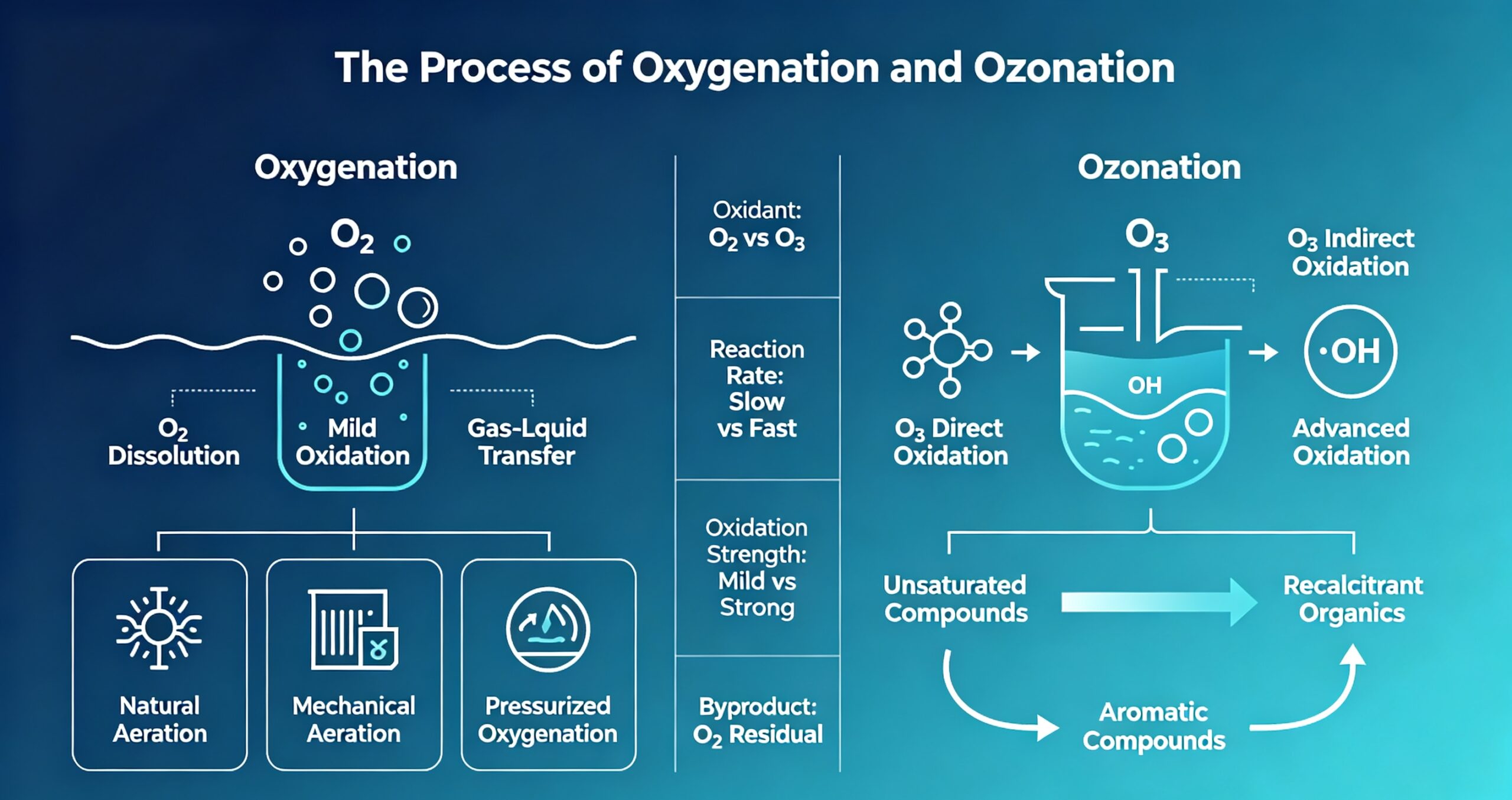
The title of the paper is referred to as The Process of Oxygenation and Ozonation. ‘ Oxygenation and ozonation are the most popular technologies of oxidation methods that have applications in various fields, including water purification and medicine. Both processes employ the reaction of free oxygen in order to get rid of pollutants and influence on biological reactions and processes. Although, both processes have many common features, they differ in some respects, including the agents used in the process, the manner of the process running, its level of oxidation, and potential use of the process. The paper describes different aspects of oxygenation and ozonation process. It also compares and contrasts the two processes.
Oxygenation and Ozonation as Processes
- Oxygenation
Oxygenation is viewed as a process of adding oxygen to the specific medium and trying to achieve its dissolution in the given medium. Oxygenation is viewed as the mild oxidation technology, as it enables the use of free state ground oxygen molecules to participate in the process. In simple terms, the process of oxygenation leads to oxidizing of substances in watered environment.
The effectiveness of using oxygenation depends on the parameters of oxygen solubility, efficiency of gas-liquid transfer, temperature, and pressure. Oxygenation technologies may be divided into natural aeration, mechanical aeration, and oxygen pressure aeration. The technique using oxygen under pressure can enhance the level of soluble oxygen. - Ozonation
Ozonation is referred to as the advanced oxidative process, where the substance used for the process is ozone. Ozone is regarded as a powerful oxidizing agent, which has redox potential 2.07 V in the aqueous solution, and is considered to be more effective comparing to molecular oxygen. Unlike the method of oxygenation, the method of ozonation involves two methods of oxidation process taking place simultaneously, which are direct and indirect oxidation processes. Direct oxidation means that ozone acts with compounds such as unsaturated hydrocarbons, aromatic compounds, etc. Indirect oxidation means that ozone is decomposed in water into hydroxyl radicals,which in turn breaks down hard-to-decompose organic substances in an efficient way through the process of oxidation. Producing ozone can be done by using dielectrical barrier method, ultraviolet method, or electrochemical method having dielectrical barrier method as the most widely spread in the world.