

Safety Evaluation and Clinical Application Progress of Intelligent Extracorporeal Blood Therapy

Clinical Application Development and Safety Investigation of Extracorporeal Blood Therapy
Abstract
Extracorporeal blood therapy is one of the most important technologies in modern medicine. It has emerged as a key technique in the spheres of intensive therapy and cardiovascular surgery. Due to the fact that in this process the blood is taken outside the body and goes through the processes of oxygenation, purification, separation, and circulation regulation, it becomes possible to temporarily assume the functions of different organs such as the heart, lungs, kidneys, and other organs. Extracorporeal blood technologies have experienced significant advancements recently because of the improvements in biomaterials as well as the development of modern and intelligent medical equipment. The article discusses the technological principle of extravascular blood therapy, its clinical application system, and existing risks concerning the good usage of this method.
- Technical Principle of Extracorporeal Blood Therapy
The basic principle of how extravascular blood therapy operates is based on the process in which the blood is taken from the body and processed in vitro before it is injected into the body again. This is performed in special sterile conditions where the entire venous blood of the patient is taken out of his/her body through a special catheter and goes through all arterial processes according to the procedure.Once the blood has been processed, it is returned to the body of the patient via the arterial or the venous circulatory system to ensure blood flow rate and maintain metabolic equilibrium.
While the traditional treatment methods give importance to the performance of the affected organs, the extracorporeal blood treatment methods overcome the limitations of the normal biological functions of the body. These methods are able to impact the blood composition and its physiological state without waiting for the affected organs to regain their functionality.
Classification and Clinical Applications
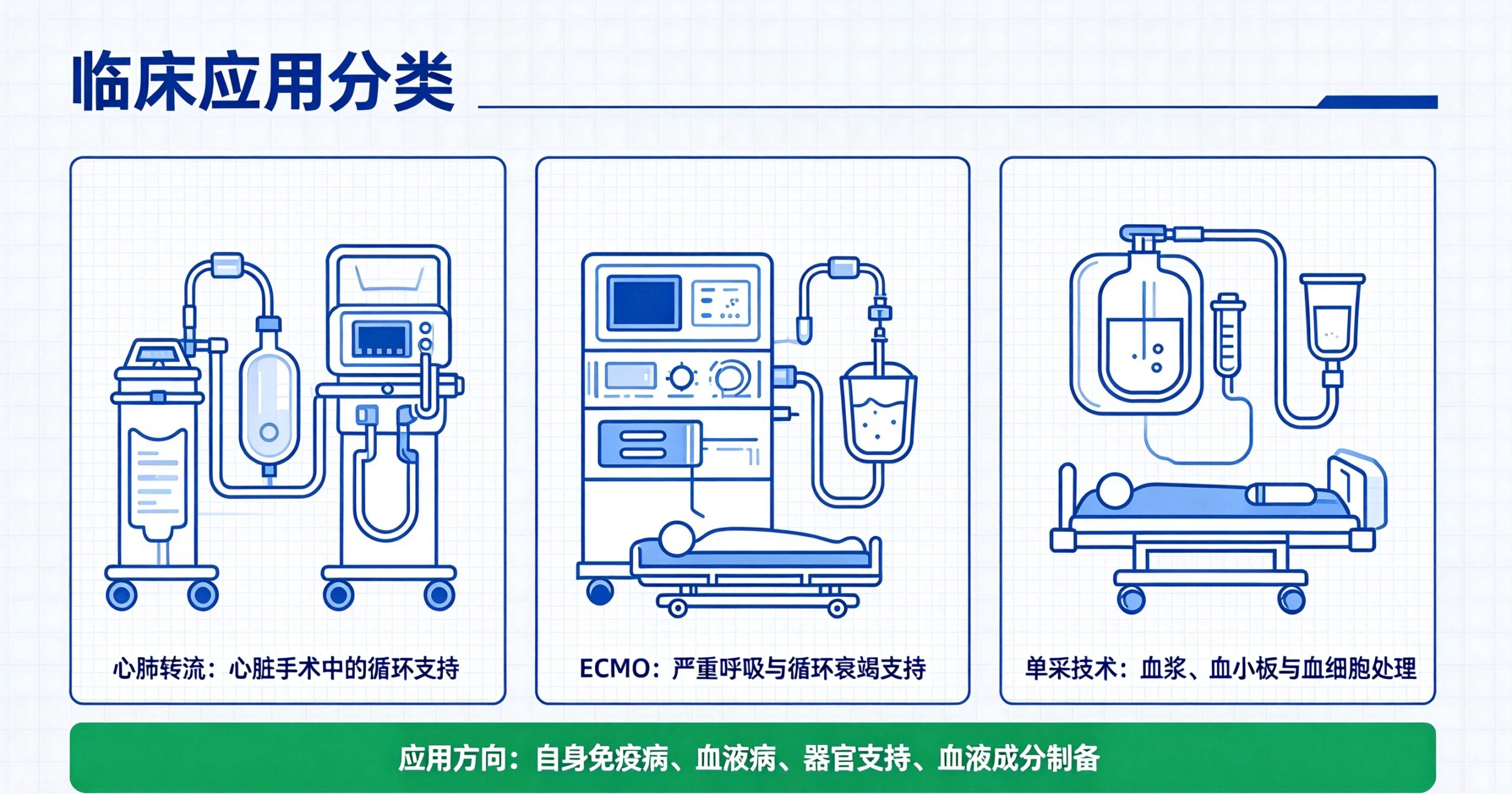
Considering the specific application, the extracorporeal blood treatment can be divided into three major types of methods.
Extracorporeal circulation therapy consisting of CPB and ECMO is the first type of extracorporeal blood treatment. CPB is used during surgeries performed on the patient’s heart when it is necessary to ensure blood flow through the patient’s body. ECMO is utilized in patients suffering from serious respiratory and circulatory issues.The third category of blood processing technology is blood component separation therapy, or apheresis technology. It helps to isolate, collect and externalize important elements of blood such as plasma, platelets, and others. This technology is being applied for treatment of autoimmune disorders, hematological diseases, and for production of blood components. - Risks of clinical safety and analysis of mechanisms
Despite being highly valuable in terms of rescue capability, blood processing technology carries some inevitable risks owing to specific features of blood processing.
Such risks include complications of bleeding and loss of blood. This is because when blood comes into contact with artificial devices, it starts activating the clotting mechanism, resulting in the risk of clot formation. In order to avoid clotting, anticoagulants must be used, which increases the risk of bleeding.
Furthermore, there may also exist the dangerous long-term consequences like inflammatory reactions and disorders of microcirculation. Blood processing causes the inflammatory response, which results in the release of inflammation markers and damages microcirculation of vital body organs, which may lead to kidney problems and dysfunctions of other organs.Conversely, the use of extracorporeal blood circulation for a prolonged period may be the reason for the development of electrolyte disturbances, acid-base imbalances, and nutritional deficiencies, making the clinical nursing much more complicated. - Recent Research and Technical Improvements
Recently, the methods and developments of extracorporeal blood therapy have mixed modern blood circulation design with additional techniques to make processes of purification more precise.
The area of material improvements is about the construction of various polymer-modified tubing and filtering compounds allowing for a better reduction of adhesion as well as activation of platelets and inflammatory cells. Therefore, there is much better biocompatibility of extracorporeal circuits, which leads to fewer cases of thrombus and complications caused by inflammation.
Concerning the area of purification technology, multi-target blood purification has become a real trend in research. The combining of the technologies such as blood hemoadsorption and plasma filtration has allowed eliminating both the macromolecular inflammatory agents and endotoxins and low-molecular-weight metabolic waste.
Modern intelligent monitoring techniques have also been extensively implemented. With the help of a real-time monitoring system, the flow of blood and count of blood cells as well as efficiency of blood purification could be controlled and aimed at the flexibility of treatment.
Concerning the area of clinical application, extracorporeal blood therapy is not necessarily related to the treatment of organ failures. It is actively used in therapy for burns, pancreatitis, and common autoimmune diseases. - General Evaluation and Proposals
Extracorporeal blood therapy is one of the leading technologies for artificial organ support and contribution and in general, plays an important role in both modern treatment and medicine. Its technical essence lies in the use of artificial equipment for the purpose of replacing and optimizing the function of blood circulation in vivo, giving a hope to people who suffer from serious organ dysfunction.
Currently, the industry faces a lot of problems such as the insufficient ability of the system to provide individual treatment.